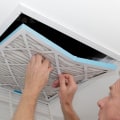
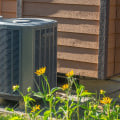
Orlando homes don't develop mold problems overnight — they develop them quietly, inside HVAC systems that haven't been serviced in over a year. In our experience servicing Central Florida homes, the most common mold entry points aren't walls or windows — they're dirty evaporator coils, clogged condensate drain lines, and undersized systems short-cycling in oversaturated air. A tune up addresses all three.
This page shows you exactly where mold hides inside your HVAC system, what a tune up does to eliminate those conditions, and why Orlando's humidity makes annual service non-negotiable — not optional.
TL;DR Quick Answers
What Is an HVAC Tune Up in Orlando?
An HVAC tune up in Orlando is a professional preventive maintenance service that inspects, cleans, and calibrates your heating and cooling system to keep it running efficiently in Central Florida's demanding year-round climate.
A standard Orlando HVAC tune up includes:
Evaporator and condenser coil cleaning
Condensate drain line flush
Airflow measurement and calibration
Refrigerant level check
Electrical connection inspection
Thermostat calibration
Full system performance evaluation
Who needs it: Any Orlando homeowner running a central HVAC system. How often: Twice yearly — spring and fall — in Central Florida's climate. Why it matters here: Orlando's humidity turns an unmaintained HVAC system into a mold risk. A tune up eliminates the moisture conditions mold depends on before they develop. What it costs: Typically $75 to $200 depending on scope. Confirm coil cleaning and drain line service are included before booking.
Bottom line: In Central Florida, an HVAC tune up isn't optional maintenance — it's the most cost-effective mold prevention and efficiency tool available to homeowners.
Top Takeaways
A tune up is mold prevention, not just maintenance. Dirty coils, clogged drain lines, and short-cycling systems are the top three mold entry points we find in Orlando homes. A professional tune up addresses all three.
Visible mold near vents means it's already inside your system. Prevention is always less expensive than remediation. Consistent annual service eliminates the moisture conditions mold needs before they take hold.
The health stakes are research-backed. A joint EPA and Berkeley Lab study links 4.6 million U.S. asthma cases directly to indoor dampness and mold. Routine HVAC maintenance targets those exact conditions.
A neglected system costs more every month. ENERGY STAR confirms poor maintenance cuts efficiency by up to 30%. In Orlando's near year-round cooling season, that loss compounds fast.
Once a year isn't always enough in Central Florida. Older ductwork, high humidity, or any mold history warrants twice-yearly service. At minimum — schedule before June.
Why Orlando HVAC Systems Are Mold's Favorite Target
Orlando averages over 50 inches of rainfall annually and routinely hits relative humidity above 90%. Your HVAC system runs almost year-round pulling that moisture-heavy air through its components. Without regular maintenance, those components become mold incubators — not air conditioners.
The three most vulnerable points in any Orlando HVAC system:
Evaporator coils — collect condensation constantly; dirty coils hold moisture longer
Condensate drain lines — clog with algae and debris, causing water to back up into the system
Air handler cabinet — dark, cool, and moist when airflow is restricted
What a Tune Up Does to Prevent Mold Growth
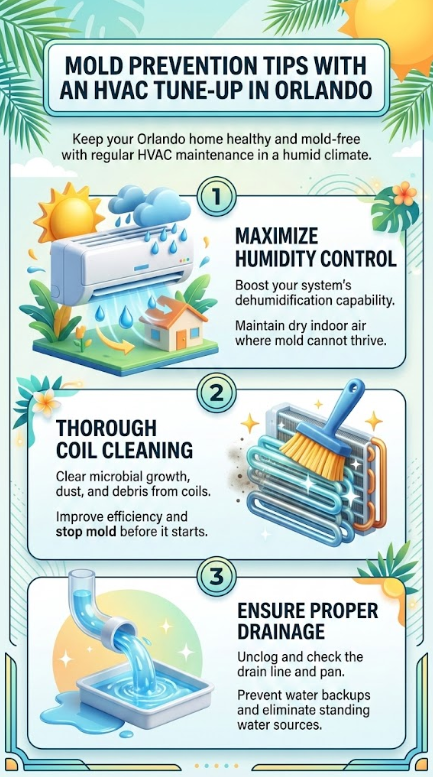
A professional HVAC tune up isn't just a performance check — in a humid climate like Central Florida, it functions as a direct mold prevention service. Here's what gets addressed:
Coil cleaning removes the biofilm layer where mold colonies establish first
Condensate drain flush clears algae buildup before standing water creates a moisture problem
Airflow calibration ensures the system isn't short-cycling, which leaves humidity uncontrolled between cooling cycles
Filter inspection and replacement eliminates trapped organic material that feeds mold spores
Cabinet and duct inspection catches early mold growth at access points before it spreads into living spaces
The Short-Cycling Problem Orlando Homeowners Miss
One of the most overlooked mold contributors in Orlando homes is an oversized or improperly calibrated HVAC system that short-cycles — cooling the air quickly but shutting off before it adequately dehumidifies the space. The result is a home that feels cool but maintains humidity levels well above the 50% threshold where mold thrives.
A tune up includes system performance evaluation that identifies short-cycling patterns. Correcting airflow and refrigerant levels keeps the system running long enough to pull moisture out of the air — not just lower the temperature.
How Often Should Orlando Homeowners Schedule a Tune Up?
Given Central Florida's near year-round cooling season, once annually isn't enough for most homes. We recommend:
Twice per year for homes with known humidity issues, older ductwork, or previous mold history
Every spring at minimum before peak humidity season hits in June
Immediately if you notice musty odors near vents, visible discoloration around registers, or allergy symptoms that worsen indoors
Mold Prevention Starts Before You See It
By the time mold is visible near your vents or registers, it has already established inside your system. The most cost-effective mold prevention strategy isn't remediation — it's consistent HVAC maintenance that eliminates the moisture conditions mold depends on. In Orlando's climate, that means treating your annual tune up as essential home maintenance, not an optional service call.

"In Central Florida homes, we don't just tune up HVAC systems for efficiency — we tune them up to cut off mold's moisture supply before it ever gets established. Nine times out of ten, the homes we service with active mold problems near the vents haven't had a condensate drain flush or coil cleaning in over two years."
Your Orlando HVAC Tune Up Research Starts Here
As neighbors who've spent years maintaining HVAC systems in Central Florida homes, we know how overwhelming it can be to sort through technical information when all you want is to protect your family's comfort and air quality. We've pulled together the seven most trusted resources on HVAC maintenance and mold prevention — so you can research with confidence and make the best decision for your home.
1. The Homeowner's Starting Point for Understanding Mold and Moisture
The EPA's foundational guide explains the direct connection between HVAC maintenance and indoor mold prevention — including why keeping drain lines clear and humidity below 60% matters so much in a climate like ours. If you're only going to read one resource before scheduling a tune up, this is the one we'd hand to our own neighbors.
URL: https://www.epa.gov/mold/brief-guide-mold-moisture-and-your-home
2. Why Your HVAC System Is the First Place Mold Takes Hold
This EPA prevention chapter is one we reference constantly when talking with Orlando homeowners — because it explains exactly how condensate pans and unmaintained ventilation components quietly allow mold to spread through an entire home before anyone notices. Understanding this is the first step toward preventing it.
URL: https://www.epa.gov/mold/mold-course-chapter-9
3. How Humidity Turns Into a Hidden Mold Problem Inside Your System
From our experience servicing Central Florida homes, humidity is the root cause behind most of the mold problems we find near vents and registers — and this EPA chapter explains why. It covers what happens when an HVAC system stops dehumidifying effectively, and why early intervention through a tune up is always less costly than remediation.
URL: https://www.epa.gov/mold/mold-course-chapter-2
4. Florida's Official Mold Guidance — Written for Homeowners in Our Climate
This isn't generic national guidance — it's Florida-specific. The Florida Department of Health resource addresses the mold conditions our state's humidity creates, and provides honest, practical direction on identification, cleanup, and who to contact locally. It's the resource we point neighbors to when they need answers grounded in Florida's reality.
URL: https://www.floridahealth.gov/environmental-health/mold/index.html
5. Central Florida Air Quality Support — Straight From the State
Florida's Indoor Air Quality Program connects Orlando-area homeowners directly to county-level resources and local contacts — because air quality challenges here aren't the same as they are in Atlanta or Phoenix. If you have concerns about what your HVAC system may be circulating through your home, this is your first call.
6. The Ventilation Standards Every Qualified HVAC Technician Should Know
ASHRAE Standards 62.1 and 62.2 set the professional benchmarks for ventilation system design and indoor air quality in both residential and commercial buildings. When we evaluate an HVAC system in your home, these are the standards guiding what acceptable performance actually looks like — not guesswork.
URL: https://www.ashrae.org/technical-resources/bookstore/standards-62-1-62-2
7. The Professional Maintenance Standard Behind Every Thorough Tune Up
ASHRAE Standard 180 defines the minimum inspection and maintenance requirements that keep an HVAC system delivering clean air, consistent comfort, and real energy efficiency. It's the difference between a technician who checks every critical component and one who just swaps the filter and calls it done — and it's the standard our team works from on every visit.
The Numbers Behind Mold, HVAC Maintenance, and Your Home's Air Quality
We don't ask our neighbors to take our word for it. After years of servicing HVAC systems across Central Florida, we've watched these numbers play out in real homes. Here's what the research confirms about what we see every day.
Stat #1 — Homes with dampness and mold carry a 30% to 70% higher risk of asthma, chronic cough, and respiratory illness.
Most Orlando homeowners call us about comfort and cooling costs — not respiratory health. But when we pull a dirty evaporator coil or clear a backed-up condensate drain, we're doing both. What we're removing:
The standing moisture that feeds mold colonization
The biological buildup on coil surfaces where spores establish first
The drainage failures that keep system components wet between cycles
Research confirms these conditions drive a 30% to 70% increase in asthma and respiratory health problems in affected homes. In Orlando, where your system runs 10 to 11 months a year, that risk builds fast. A tune up remains the most cost-effective way to cut it off at the source.
Source: Indoor Air Quality Science — Lawrence Berkeley National Laboratory (iaqscience.lbl.gov)
4.6 million U.S. asthma cases trace directly back to dampness and mold inside the home.
That number stops homeowners cold when we share it during a consultation — and it should. A joint EPA and Berkeley National Laboratory study found:
21.8 million Americans currently live with asthma
4.6 million of those cases are directly attributable to indoor dampness and mold exposure
The source isn't outdoor air or seasonal allergens — it's inside the home
In our experience, the homes behind that statistic share a common thread: HVAC systems that hadn't been serviced in two or more years. When we find standing water in a drain pan or biological growth on a coil during a tune up, we're looking at exactly the conditions that study describes. Catching it early costs a few hundred dollars. Missing it can affect your family's health for years.
Source: Global Indoor Health Network — EPA/Berkeley Lab Joint Study (globalindoorhealthnetwork.com)
Nearly half of your home's total energy use goes to heating and cooling — and a neglected system wastes up to 30% of that.
We hear it from Orlando homeowners regularly: "My electric bill keeps climbing but nothing's changed." Something has changed — the system has. Here's what ENERGY STAR data confirms:
Nearly 50% of all home energy consumption goes to heating and cooling
Poor maintenance alone can reduce system efficiency by up to 30%
The result is longer run cycles, reduced dehumidification, and higher utility bills
What that looks like in a Central Florida home is a system working harder to deliver less. A professional tune up — coil cleaning, airflow calibration, refrigerant check — restores the efficiency that's been quietly bleeding out between service visits. In our experience, homeowners who stay current on maintenance don't just breathe better air. They pay noticeably less to do it.
Source: ENERGY STAR — U.S. Environmental Protection Agency (energystar.gov)
Final Thoughts: Why Orlando Homes Can't Afford to Skip the Tune Up
Most HVAC maintenance conversations start with efficiency — lower bills, longer system life, fewer emergency calls. After years of servicing Central Florida homes, our honest opinion is that the more important conversation is the one most homeowners never have until something goes wrong.
Orlando's climate doesn't give HVAC systems a recovery period.
The same humidity that makes summers unbearable works inside your system every day:
Condensing on coil surfaces
Pooling in drain pans
Building the moisture conditions mold depends on
By the time you smell something musty near a vent, the problem isn't new. It's just finally visible.
After hundreds of service calls across Central Florida, here's what we've come to believe:
A tune up isn't a maintenance expense — it's a moisture management strategy
Homes with serious mold problems aren't unusual — they just skipped one or two service cycles too many
Catching a clogged condensate drain early is never dramatic — but missing it almost always is
In Orlando's climate, annual service is the industry standard because the alternative consistently costs more
Our honest opinion — and we'll stand behind it:
No home service delivers more preventive value per dollar in Central Florida than a professional HVAC tune up. Not because it's what we do. Because the evidence we see in the field, season after season, keeps pointing to the same conclusion:
Families who maintain their systems consistently breathe better air
They spend less on repairs
They never have to learn what mold remediation costs the hard way
FAQ on HVAC Tune Up in Orlando
Q: How often should I schedule an HVAC tune up in Orlando?
A: Twice a year — not once. Here's why:
Orlando systems run nearly year-round with no natural recovery period
Continuous demand accelerates wear on every component a tune up protects
Spring service prepares your system before June humidity peaks
Fall service catches what summer put it through
Once a year is the industry minimum. In Central Florida, it's not enough. Homes with older ductwork, mold history, or persistent humidity issues should treat twice-yearly service as the baseline — not a premium option.
Q: What does an HVAC tune up in Orlando actually include?
A: Not every tune up is equal — and in Central Florida, the difference matters more than most climates. A thorough Orlando tune up includes:
Evaporator and condenser coil cleaning
Condensate drain line flush and inspection
Airflow measurement and calibration
Refrigerant level check
Electrical connection inspection and tightening
Thermostat calibration
Blower component cleaning
Full system performance evaluation
The two steps that separate a real tune up from a basic filter swap are coil cleaning and the condensate drain flush. Those are the exact points where mold establishes first in Florida homes. If a provider's checklist doesn't explicitly include both — ask why before they arrive.
Q: How much does an HVAC tune up cost in Orlando?
A: Most professional tune ups in Orlando range from $75 to $200. But price isn't the right question. Scope is. Before booking, confirm these three things are included:
Coil cleaning
Condensate drain line flush
Airflow calibration
A $75 tune up that skips all three isn't a tune up — it's a filter check. A thorough $175 service will almost always cost less than the first hour of the mold remediation call it prevents.
Q: Can an HVAC tune up in Orlando actually prevent mold growth?
A: Yes — and in our experience, it's the single most effective mold prevention step available to Central Florida homeowners. More targeted than air purifiers. More reliable than standalone dehumidifiers. Less expensive than every remediation option by a significant margin.
A tune up cuts off mold's moisture supply by targeting its four entry points:
Clearing condensate drain lines before standing water develops
Cleaning evaporator coils where biofilm and mold colonies establish first
Correcting airflow issues that cause short-cycling and incomplete dehumidification
Replacing filters that trap the organic material mold spores feed on
We've never seen a mold problem inside a well-maintained HVAC system. Consistent moisture control is why.
Q: How do I know if my Orlando HVAC system is overdue for a tune up?
A: The warning signs homeowners dismiss are usually the ones that matter most. Watch for:
Musty or stale odors from vents when the system runs
Visible discoloration or dark spotting around registers
Rooms that feel humid even with the AC running
Utility bills climbing without explanation
Allergy or respiratory symptoms that worsen indoors
Longer run cycles to reach the set temperature
Any one of these warrants a call. More than one means the tune up is already overdue. In Orlando's climate the gap between "probably fine" and "now it's a mold problem" is shorter than most homeowners expect — and a tune up is almost always what closes it.
Ready to Stop Mold Before It Starts? Schedule Your Orlando HVAC Tune Up Today.
Orlando's humidity works against your home every day your HVAC system goes without service — don't wait for a musty smell or a climbing utility bill to make the call. Contact your trusted local HVAC experts today to schedule your professional tune up and give your family the clean, efficient air they deserve.Here is the nearest branch location serving the Coral Gables FL area…
Filterbuy HVAC Solutions - Miami FL
1300 S Miami Ave Unit 4806, Miami, FL 33130
(305) 306-5027